

No products in the cart.
feiniwy.ch
Grape varieties - Sangiovese
- Grapes, Wine knowledge
- All contributions
The Sangiovese grape variety It shapes the great red wines of central Italy like almost no other and delights discerning wine lovers seeking elegance, freshness and depth in their glass. As Weinbüro Felber at Feiniwy In this article, we’ll guide you through the origins, style and food pairings of this fascinating grape – with practical recommendations for your own wine cellar.
The origins of the Sangiovese grape variety: the blood of Jupiter and the heart of Tuscany
The name Sangiovese is thought to be derived from „Sanguis Jovis“, which means „blood of Jupiter“. This name alone demonstrates the high status this grape variety holds in Italian wine culture. Sangiovese originates from central Italy, primarily in Tuscany, and from there it has spread to other regions such as Emilia-Romagna, Umbria, Marche, Lazio and Abruzzo.
Sangiovese is the most widely grown red grape variety in Italy and dominates numerous DOC and DOCG regions. In Tuscany, it forms the basis for Chianti, Chianti Classico, Brunello di Montalcino, Vino Nobile di Montepulciano and Morellino di Scansano. In many appellations, the regulations stipulate a minimum Sangiovese content of 70–100 %; for Brunello di Montalcino, this is as high as 100 %.
Over time, a wide variety of local synonyms have emerged: Morellino in the Maremma, Prugnolo Gentile in Montepulciano, Brunello in Montalcino and Nielluccio in Corsica. This diversity reflects the deep roots of the Sangiovese grape variety in its regions of origin.
Grape variety profile: Characteristics of the Sangiovese grape in the vineyard
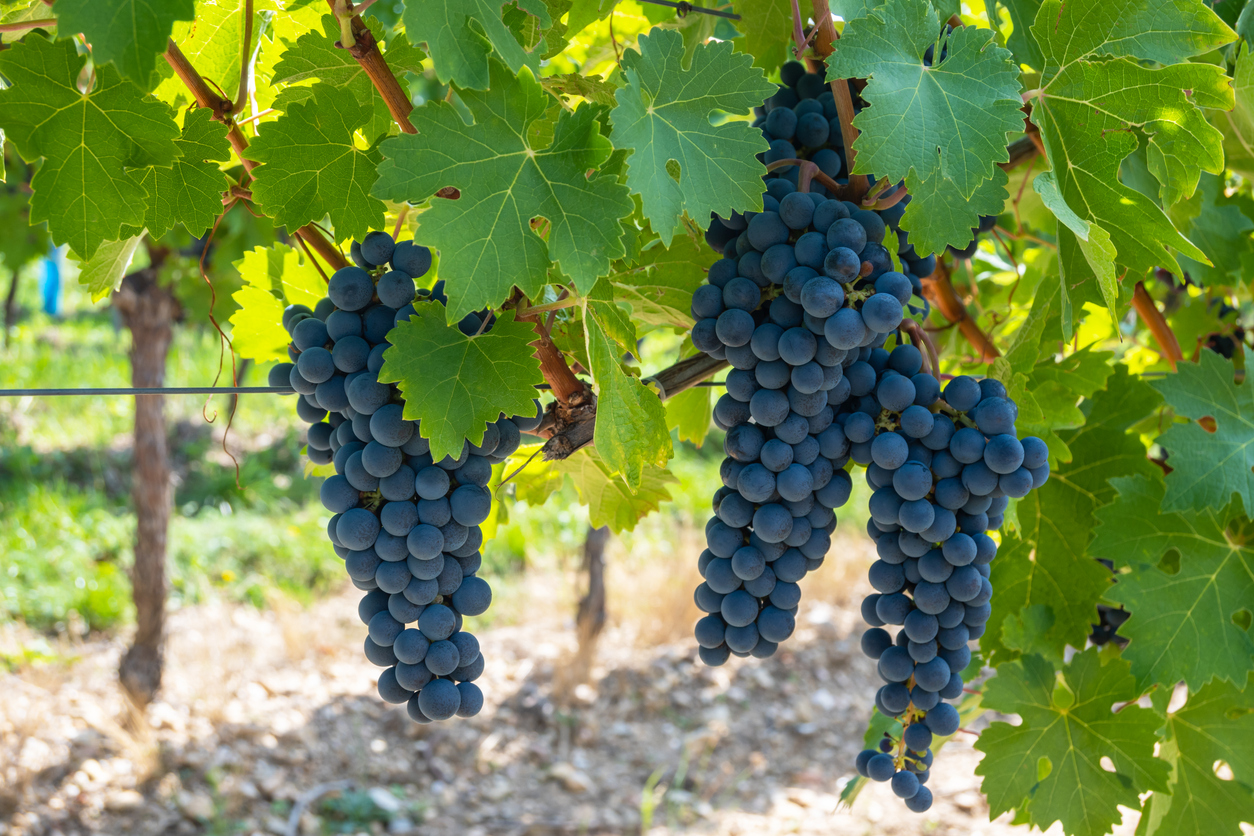
The Sangiovese grape variety ripens relatively late, prefers warm but not hot locations, and thrives in well-drained, stony soils. In Tuscany, it thrives particularly on Galestro (crumbly slate-marl) and Alberese (calcareous sandstone). These soils promote the delicate acidity and distinctive tannin structure that are typical of Sangiovese red wine.
Sangiovese produces medium-thick grape skins that are rich in tannins and pigments, though never as deep in colour as those of Syrah or Cabernet Sauvignon. The variety is sensitive to yield levels: Quality-conscious winegrowers work with reduced yields, in order to preserve concentration, aromatic complexity and harmony. High yields, on the other hand, result in thin, high-acidity wines with harsh tannins.
What does Sangiovese taste like? Aromas and style in the glass
Many wine lovers ask: „What does Sangiovese taste like?“ The answer depends on the origin, vinification and maturity, but there are nevertheless some typical guidelines.
Primary aromas (fruity and floral notes):
- Sour cherry, red cherry, sometimes black cherry
- Redcurrant, plum, pomegranate
- Violets, dried herbs, Mediterranean scrub
Secondary and tertiary aromas (ageing, maturation):
- Leather, tobacco, dried tomato
- Tar, undergrowth, earth
- Spicy notes such as cloves, liquorice and, occasionally, a hint of smoke
On the palate, Sangiovese fresh, lively acidity, medium to pronounced tannins and a medium to full body. The texture is often juicy, with a firm structure rather than opulent sweetness. In classically styled Sangiovese red wines, freshness, elegance and length take centre stage, rather than opulence.
Sangiovese red wine, white wine and rosé: what styles of wine are there?
The Sangiovese grape variety is primarily a red grape variety, meaning it is mainly used to produce red wine and rosé. Nevertheless, the term „Sangiovese white wine“ does occasionally crop up, usually in connection with Blanc de Noirs styles or wines made from red grapes using white winemaking techniques.
- Sangiovese red wine: The classics – from straightforward IGT wines to iconic Brunello di Montalcino.
- Rosato / Rosé made from Sangiovese: Fruity, well-structured rosé wines with hints of cherry and lively acidity.
- „Sangiovese white wine“: rare wines in which the time the grapes spend in contact with the skins is kept to a minimum in order to produce a light-coloured wine that retains the variety’s acidity and freshness.
For everyday enjoyment and your wine cellar at Fine red wines Sangiovese is clearly synonymous with red wine that reflects its terroir.
Sangiovese and Chianti, Brunello & Co.: An overview of the styles of the main wine-growing regions
The question „Is Sangiovese Chianti?“ comes up frequently. Sangiovese is the grape variety, whilst Chianti is the designation of origin. Chianti is made predominantly from Sangiovese, supplemented by other varieties depending on the style, but it is not a synonym.
The table below provides a concise overview of the main Sangiovese growing regions and their styles:
| Origin | Proportion of Sangiovese | Typical style | Taste Window |
|---|---|---|---|
| Chianti / Chianti Classico | at least approx. 70–80 % | Juicy cherry, fresh acidity, medium body, often aged in oak | 3–10 years, depending on the quality grade |
| Brunello di Montalcino | 100 % Sangiovese (Brunello) | A dense structure, darker fruit, pronounced tannins, and excellent ageing potential | 8–25 years, with top vintages lasting even longer |
| Vino Nobile di Montepulciano | predominantly Sangiovese (Prugnolo Gentile) | Ripe cherry, spice, harmonious tannins, elegant body | 5–15 years |
| Morellino di Scansano | at least 85 % Morellino (Sangiovese) | Warmer fruit, softer, more approachable, Mediterranean character | 2–8 years |
| Super Tuscans (Sangiovese-based) | high proportion of Sangiovese, often blended with Cabernet and Merlot | Powerful, well-structured, with an international style and Tuscan freshness | 8–20 years |
You can also find many of these origins in the range of high-quality Italian wines at Feiniwy – ideal for tasting the stylistic differences in a direct comparison.
A comparison of Sangiovese grape varieties: Not Pinot Noir, not Primitivo – but some exciting alternatives
The question comes up regularly: „Is Sangiovese a Pinot Noir?“ – quite clearly: no. Both grape varieties produce elegant red wines, but they differ significantly:
- Pinot Noir: Thin-skinned, very delicate, fragrant, generally lower in tannins, with red berry and floral notes, and often lighter-bodied.
- Sangiovese: A more pronounced tannin structure, higher acidity, distinct cherry notes, and often spicier and more robust.
Those who love Pinot Noir will find a more structured, „Tuscan“ take on lightness in finely crafted Chianti Classico or elegant Vino Nobile. You can find a more in-depth look at Pinot Noir in the article on Pinot Noir grape varieties on Feiniwy’s blog.
Also Sangiovese and Primitivo are often lumped together, particularly among customers who are just discovering Italian red wines. Primitivo from Apulia or Zinfandel-style wines from overseas usually offer dark fruit, high alcohol content and a soft, ripe texture. Sangiovese, by contrast, is leaner and fresher, with pronounced acidity and cherry-spiced aromas. Those coming from velvety Primitivo wines will find an exciting transition into the world of Sangiovese via Morellino di Scansano or softer Chianti Riserva.
How does Sangiovese pair with food? Food pairings for connoisseurs
For food lovers in Switzerland, the Sangiovese grape variety offers a wide range of pairing options with both traditional and modern cuisine. The combination of acidity, tannins and cherry fruit pairs particularly well with dishes rich in fat, protein and umami.
Perfect for:
- Wood-fired pizza with tomato sauce, mozzarella, mushrooms or salsiccia
- Pasta with tomato sauces, ragù alla bolognese, sugo di cinghiale
- Mature hard cheese, Pecorino, Sbrinz, mature Gruyère
- Braised meat dishes such as ossobuco, brasato and lamb shank
- Spicy barbecued dishes made with beef, veal or lamb
The fresh acidity of Sangiovese cuts through fat, the tannins bind with proteins, and the cherry flavours pair wonderfully with tomato, herbs and toasted notes. Anyone wishing to explore wine and food pairings in greater depth will find the article on Wine and cheese pairings some extra inspiration.
Shopping tips: Sangiovese wine for beginners and connoisseurs
When shopping, the question often arises as to how affordable everyday wines differ from more sophisticated vintages. In discount stores, with labels such as „Aldi Sangiovese“ or „Coop Sangiovese“, you’ll usually find simple, fruit-forward wines that are a pleasure to drink straight away. For connoisseurs who appreciate origin, terroir and ageing potential, it’s worth checking out specialist retailers.
A guide to buying Sangiovese varietal wines:
- IGT / Sangiovese Rubicone, Sangiovese Toscana: straightforward, often fruit-forward wines, ideal for everyday drinking, pizza and pasta.
- Chianti / Chianti Classico: excellent value for money; Riserva wines offer greater depth, complexity and ageing potential.
- Brunello di Montalcino: Sangiovese of the very highest quality, with great ageing potential and complex aromas.
- Super Tuscans: Sangiovese-dominated blends with international grape varieties, often aged in barriques, modern and well-structured.
The range at Italian red wines at Feiniwy You’ll find a carefully curated selection of Sangiovese wines covering a range of styles and price points – from approachable Chianti to top-quality Tuscan wines with good ageing potential.
Storing and serving: How to get the best out of Sangiovese
Sangiovese benefits from careful ageing and being served at just the right moment. For Feiniwy’s target audience, who consciously celebrate the pleasure of fine wine, it is worth taking a quick look at the key factors.
Storage:
- Temperature: Constant at around 12–14 °C
- Light: Dark, with no direct sunlight
- Position: Lying down, so that the cork stays moist
- Consumption window:
- Basic IGT and Chianti: 2–5 years
- Chianti Classico Riserva, Vino Nobile: 5–15 years
- Brunello di Montalcino, top-quality Super Tuscan: 10–25 years
You can find more detailed, general advice on wine storage in the guide „10 Tips for Storing Wine at Home“ on the Feiniwy blog.
Serving temperature and decanting:
- Ideal serving temperature: 16–18 °C; not too warm, so that the acidity remains fresh.
- Young, firm Sangiovese red wines benefit from being left to breathe in a decanter for 1–2 hours, whilst older, mature wines benefit from being gently decanted shortly before serving.
It is through this meticulous care that the Sangiovese grape variety reveals its full potential – from its crystal-clear cherry fruit to its complex, spicy finish.
Frequently asked questions about the Sangiovese grape variety
Is Sangiovese the same as Chianti?
No, Sangiovese is the grape variety; Chianti is the designation of origin. Chianti and Chianti Classico are predominantly Sangiovese red wines, often with small proportions of other varieties, but „Chianti“ refers to the region and the style of wine. The Sangiovese grape variety forms the basis; the name ‘Chianti’ refers to the region, the set of regulations and the characteristic flavour.
What is the name of the most widely grown grape variety in Tuscany?
The most widely grown grape in Tuscany is Sangiovese. It dominates Chianti, Chianti Classico, Brunello di Montalcino, Vino Nobile di Montepulciano and Morellino di Scansano. Anyone drinking Tuscan red wine will almost always have Sangiovese in their glass, regardless of whether the wine is labelled as a Sangiovese, a Chianti or a Brunello.
Is Sangiovese a Pinot Noir?
Sangiovese is not Pinot Noir. Both produce elegant red wines, but they are clearly different: Pinot Noir offers very fine tannins, red berry flavours and a rather delicate structure, whilst the Sangiovese grape variety is characterised by higher acidity, more robust tannins and pronounced cherry and herbal aromas. Those who appreciate Pinot Noir will find Sangiovese to be a more structured, spicier counterpart.
What sort of wine is Sangiovese?
Sangiovese is a red grape variety used primarily to produce structured red wines. Typical characteristics include sour cherry, red berries, herbal notes, fresh acidity and a medium to full body. Well-known wines made from the Sangiovese grape include Chianti, Chianti Classico, Brunello di Montalcino, Vino Nobile di Montepulciano, Morellino di Scansano and numerous Sangiovese-dominated Super Tuscans.
How does Sangiovese compare to Primitivo in terms of flavour?
Sangiovese tastes cooler, fresher and more crisp than Primitivo. Whilst Primitivo usually displays dark fruit, soft tannins and noticeable residual sweetness, Sangiovese, on the other hand, offers Sangiovese red wine It offers cherry-driven flavours, more pronounced tannins and lively acidity. Those accustomed to Primitivo or Zinfandel will find Sangiovese to be a more elegant, better-structured interpretation of Italian red wines.
Is there such a thing as Sangiovese white wine?
Traditionally, Sangiovese is regarded as a red grape variety used for red wine and rosé. You may occasionally come across „Sangiovese white wine“ – either a wine made from red grapes using the white wine method, or an experimental Blanc de Noirs. These wines make the most of the Sangiovese grape’s fresh acidity and finesse, but remain niche products. In everyday terms, Sangiovese is clearly synonymous with characterful red wine.
Where can I buy high-quality Sangiovese wines online?
You’ll find high-quality Sangiovese wines – from Chianti Classico and Brunello to modern Super Tuscans – in the carefully curated range from Italian Sangiovese red wines at Feiniwy. At Weinbüro Felber, we place great importance on authenticity of origin, a variety of styles and a range that delights both connoisseurs and curious newcomers alike.
Wines at fair and transparent prices
feiniwy.ch
- Sales
- Novelties
- Alcohol-free products
- Red wines
- White wines
- Rosé wines
- Sparkling wines/champagne
- Olive oil
Felber wine office
feiniwy.ch