
No products in the cart.
feiniwy.ch
Bottling the wine
- Winemaking in the cellar
- All contributions
Anyone who loves wine thinks of grapes, terroir and ageing in barrels. The Bottling the wine often seems like a technical finishing touch. From the point of view of Weinbüro Felber and Feiniwy, however, this phase is an art in its own right: it combines oenology, hygiene management and sensory analysis - and it determines whether the wine arrives in the glass as the winemaker intended.
Bottling the wine does not simply mean emptying a tank into bottles. It's about stability, flavour protection, shelf life, ageability and, to a certain extent, style. In this article, we take you step by step: from preparation in the cellar to bottling technology and practical tips for conscious enjoyment and purchasing in the premium segment.
What exactly does „bottling the wine“ mean?
Under the Bottling the wine In oenology, bottling is the transfer of a finished wine from a barrel or tank into bottles or, rarely, into other containers. Only with this bottling does the wine leave the protected cellar cycle and come into contact with a new environment: oxygen, light, temperature changes, transport.
For discerning wineries and retailers like Feiniwy, bottling fulfils several tasks:
- The wine gets its final container shape and becomes tradable.
- Microbiological and chemical processes are largely slowed down.
- Maturation shifts from the barrel to the bottle.
- Origin, vintage, style and quality standards are communicated by the label, bottler's statement and closure.
From the consumer's point of view, bottling serves as a bridge: Between the artisanal process of Working in the vineyard, the fermentation, the ageing - and the moment you pour the wine at home.
From young wine to bottling maturity: preparation for bottling
Before a wine even comes close to a bottling plant, it needs stability. The Bottling the wine always follows a phase of clarification, maturation and inner „order“.
Step 1: Clarification, fining and filtration
After alcoholic fermentation, every young wine contains lees: Yeast cells, pulp residues, proteins, crystals. These particles not only spoil the appearance, they also jeopardise stability in the bottle. This is why quality-orientated producers work with a mix of:
- Drawing off the yeast and gentle racking
- natural sedimentation during rest periods
- Targeted fining to bind unstable proteins or tannins
- Filtration in graduated fineness
In the blog of the Felber wine office you will find the Alcoholic fermentationthe malolactic fermentation BSA and the Ageing of the wine stages have already been explained. The bottling follows on seamlessly from this.
Essential: „Blank“ does not mean flavourless. The art lies in removing lees without robbing the wine of its texture and complexity.
Step 2: Chemical and microbiological stability
A wine that rests in bottles faces a new risk: any remaining yeast or bacteria can lead to secondary fermentation, cloudiness and off-flavours. That's why quality-conscious businesses pay attention:
- Suitable sulphur dioxide content to protect against oxidation and microorganisms
- Controlled concentration of proteins and tartaric acid to avoid subsequent crystallisation
- Correct filtration fineness, matched to the type of wine (fresh white wine, long matured red wine, residual sweet speciality)
This is particularly important for premium wines with storage potential: As little intervention as possible, as much protection as necessary. Depending on the style, winemakers decide whether to carry out a final fine filtration before bottling or to opt for unfiltered bottlings, which require greater care in terms of hygiene and sulphurisation.
Step 3: The right filling maturity
In terms of time, too, the Bottling the wine A sure instinct. A wine bottled too early often comes across as restless, edgy and reductive. A wine bottled too late loses freshness, primary fruit and vigour.
- Fresh white wines and uncomplicated rosés are bottled shortly after ageing to preserve fruit and tension.
- Sophisticated red wines from grape varieties such as Cabernet Sauvignon, Pinot Noir or Tempranillo mature longer in barrels or tanks and only then reach their bottling maturity.
The cellar master uses tastings and laboratory analyses to find the optimum point in time. For you as a connoisseur, this subtlety is later revealed in the glass: balance, clarity and inner calm of the wine.
This is how the wine bottling process works technically
The modern Bottling the wine combines precision technology with hygienic rigour. In the premium segment in particular, a seemingly sober sequence becomes a decisive quality filter.
Cleaning and preparing the bottles
Cleanliness also plays a key role for brand-new glass bottles. Dust, glass particles or packaging residues must not get into the wine. That is why the preparation includes
- Depalletising and automatic bottle erection
- Blowing out or rinsing with sterile air or water
- Optional steam stage for sensitive products
Washing systems are also used in reusable cycles. In the high-quality wine segment, glass generally remains disposable in order to avoid scratches, odour transfer and long transport routes for the return of empties.
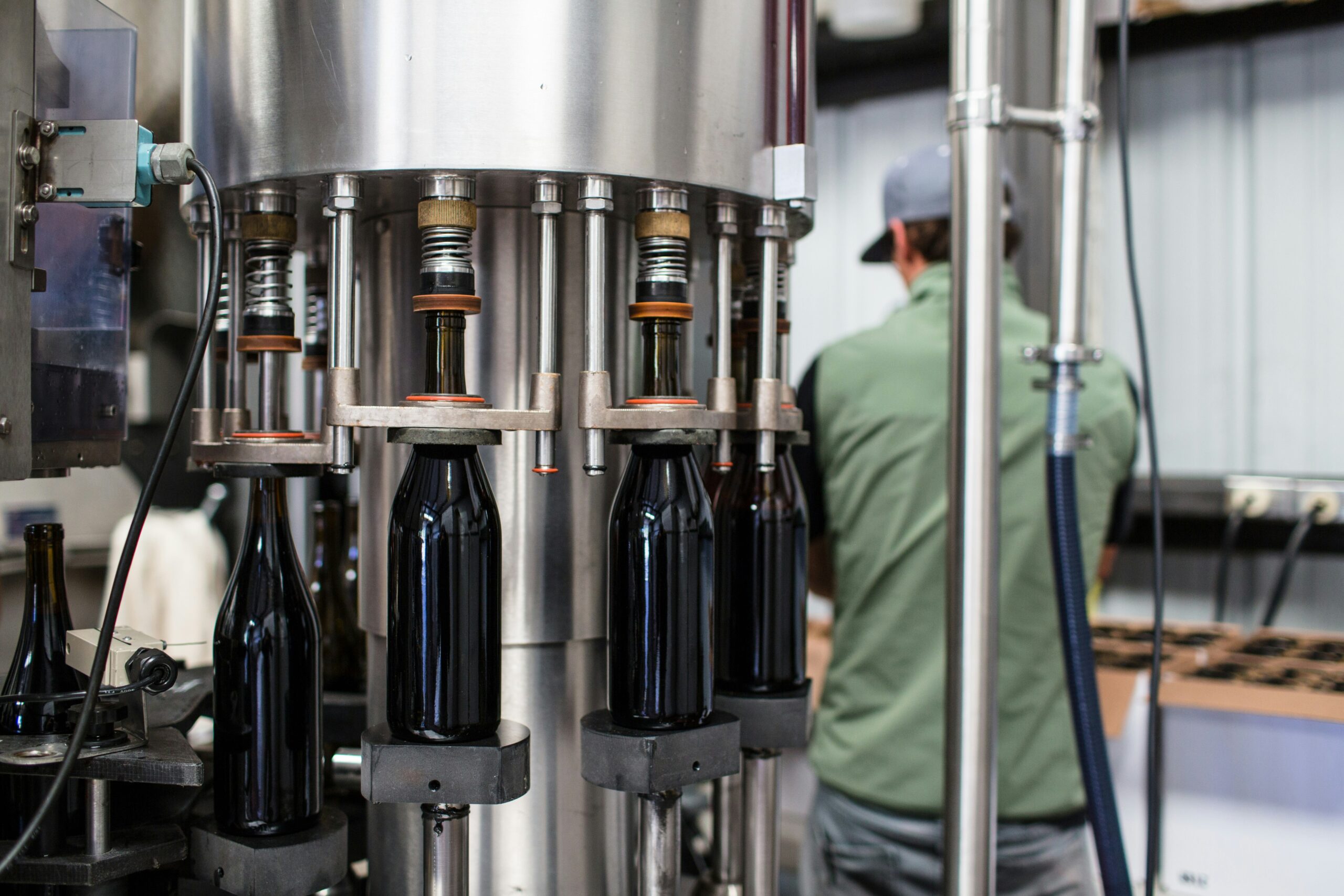
Filler: From tank to bottle - controlled and gentle
The critical part of the process begins at the actual filler. Bottling the wine. The aim: to fill every bottle with an identical filling volume, minimised oxygen input and consistent hygiene.
Typical steps:
- Feeding the wine from a prepared pressurised tank or buffer tank
- Deaeration or vacuum to remove air from the empty bottle
- Filling under normal pressure, counterpressure or with protective gas (nitrogen, carbon dioxide), depending on the type of wine
- Precise fill level, often checked by sensors
The higher the quality of the wine, the more often wineries work with inert gas. This keeps the oxygen pick-up during bottling very low and the flavour of the wine retains its precision.
Closures and capsules: Function and style
The company seals the bottle airtight immediately after filling. This determines not only the practical shelf life, but also the ageing potential.
Common variants:
- Natural cork - classic closure with fine oxygen permeability, ideal for storable wines
- Technical cork or Diam - controlled oxygen rate, lower risk of cork defects
- Screw cap - practical, very tight, excellent for fresh white wines and aromatic varieties
- Glass closure - aesthetic, neutral in flavour, good for high-quality wines that are to be drunk rather early
The choice of closure characterises the development dynamics after bottling. A tight screw cap keeps the primary fruit fresh for a long time, while a fine natural cork allows the wine to mature more slowly in the bottle.
Labelling, packaging, release
At the end of the Bottling the wine followed by visual and legal fine-tuning:
- Labelling with details of origin, vintage, grape variety, alcohol content, filling quantity and bottler
- Attach a back label with additional information, often including food recommendations
- Application of the capsule for optical and hygienic sealing
- Storage in cartons or wooden crates, often with short periods of rest before the wine goes on sale
For wine merchants like Feiniwy, this phase forms the basis for reliably assessing the wine's sensory properties and integrating them into curated product ranges - whether for French wines, Italian top plants or strong character Swiss wine.
Quality aspects when bottling wine: what professionals pay attention to
The purely technical description only captures part of the reality. At the level of quality, routine everyday bottling differs from purposeful premium work.
Oxygen management: controlled handling of oxygen
Oxygen is the greatest antagonist during bottling. Too little leads to reductive notes, too much causes wine to age prematurely. Key figures such as „Total Package Oxygen“ describe the total oxygen content in the bottle and headspace.
Premium wineries control this parameter:
- Gentle pumps and short pipe runs
- Inert gases in tank, filler and bottle
- Precise adjustment of fill level and temperature
- Selection of a suitable closure with defined permeability
For you as a connoisseur, this management has a direct effect: A wine that appears „fresh but not nervous“ after bottling and remains stable in the glass for hours benefits from well thought-out oxygen management.
Hygiene and microbiology
Each Bottling the wine requires a perfectly hygienically prepared filling cellar. Pipes, tanks and fillers are cleaned and disinfected with alkalis, acids and hot water. Residues from cleaning agents must not end up in the wine, nor must bacterial colonies.
Microbiological control is particularly challenging for residual sweet wines or natural wines with low sulphur content. Many wineries use this method:
- Regular microbiological tests
- Controlled filtration through to sterile filtration
- Tightly synchronised filling schedules to minimise system downtimes
Filling temperature and rest periods
The temperature at the Bottling the wine influences both the volume and solubility of gases. Wines with too high a temperature foam, oxygen input increases and the filling level fluctuates. Wines that are too cold react sluggishly, form chill haze and appear closed after bottling.
This is why expert cellar masters work with stable, rather cool temperatures in the range of around 10-16 °C, tailored to the type of wine and target style. After bottling, the wines are given a resting phase in storage, during which mechanical stresses are equalised and any filling shocks subside.
Bottling the wine and sensory analysis: what you perceive in the glass
For wine lovers, the question arises: How does the Bottling the wine noticeable in concrete terms? Some typical observations:
- Young freshness after the filling: Aromatic white wines in particular appear very present immediately after bottling, with clear primary fruit and lively acidity.
- Bottle ageing: After months or years, the wine develops tertiary flavours - notes of leather, tobacco and dried herbs in red wines, honey, nuts and wax in white wines.
- Reduction or oxidation: A cuvée that has been bottled extremely reductively initially shows smoky, sulphurous or light rubbery notes that dissipate with air. A wine bottled too oxidatively appears dull, brownish, with apple or sherry notes that do not match the style.
If you are targeting Feiniwy Buy wine online, you will experience this path already curated: We filter our range according to wines whose bottling and storage quality convinces us and regularly taste how the bottles develop.
Producer bottling, retailer bottling & co.: What labels reveal
The Bottling the wine is not only a technical step, but also a clearly defined legal one. You will find designations on the labels that make the wine's journey transparent.
Terms on the bottling label
- „Producer bottling“ or „estate bottling“: The company that produces the wine bottles it on its own estate. This indicates a closed value chain.
- „Bottled by ...“: Bottling takes place at a company that is not necessarily the grape producer. This is common with co-operative models or larger wineries.
- „Mis en bouteille au château / à la propriété“: Common reference in France to bottling directly at the winery.
When selecting the product range, we at Weinbüro Felber pay close attention to this information. They provide indications of quality philosophy, loyalty to origin and independent style - criteria that are essential for a premium shop like Feiniwy.
Bottling of the wine and type of wine: still wine, sparkling wine, sweet wine
The requirements, technology and target parameters of bottling vary significantly depending on the style. Three examples:
Still wine: calm and clarity
For non-carbonated white and red wines, the focus is on a clear sensory profile, microbiological stability and suitable ageing potential. Filling is usually carried out under inert gas, with moderate pressure, smooth filling behaviour and precise headspace determination.
Sparkling wine and champagne: pressure in the bottle
Sparkling wines - from Franciacorta to Cava and Champagne - often undergo a second fermentation in the bottle or in a tank. The Bottling the wine also includes the adjustment of pressure, dosage and residual sweetness.
For our sparkling wines and Champagne in the range we pay attention to traditional methods with long bottle maturation, as the fine perlage and complex yeast aroma are decisively linked to this special form of bottling.
Sweet wines and residual sweet specialities
A higher sugar content provides food for microorganisms. This is why bottling sweet wines requires close interaction between filtration, sulphurisation and hygiene. For top wines, the producer can work with less intervention, but then utilises experienced laboratory analysis and high-precision filling technology.
Table: Important parameters for bottling the wine at a glance
| Aspect | Importance in bottling the wine | Effect in the glass |
|---|---|---|
| Filling time (filling maturity) | Coordination of ageing time and maturity | Balance between freshness, structure and complexity |
| Oxygen Management | Checking the oxygen input during filling | Shelf life, ageing potential, subtlety of flavours |
| Filtration / clarification | Removal of particles and microorganisms | Brilliance, stability, texture of the wine |
| Filling temperature | Influence on foam behaviour and gas solubility | Clarity of flavour, cold or heat clouding |
| Closure type | Regulation of oxygen exchange in the bottle | Development speed, flavour profile, shelf life |
| Hygiene of the system | Avoidance of microbial contamination | Freedom from off-tones, clean flavour profile |
What does the bottling of the wine mean for you as a buyer at Feiniwy?
For quality-conscious connoisseurs, a pragmatic question arises: How do you utilise the knowledge of the Bottling the wine in everyday life, when shopping or serving?
Reading labels and making decisions
Anyone who understands the term „bottling“ on labels can better appreciate the background:
- „Estate bottling“ and related indications suggest a high level of control by the producer.
- Indication of the bottler allows conclusions to be drawn about the style - from boutique wineries to specialised wineries.
- Vintage in combination with grape variety and origin provides an indication of how far the wine has matured in the bottle.
For example, if you want to buy a matured Buy red wine or a fresh Order white wine, this „literacy“ forms the basis for targeted choice: for spontaneous enjoyment, for storage or as a gift.
Bottling, storage and consumption window
The quality of the Bottling the wine only realises its value in conjunction with proper storage:
- Constant, rather cool temperatures
- Protection from light, especially UV radiation
- Can be stored horizontally with cork stopper, vertically with screw cap
A carefully bottled wine that is stored in this way shows a clearly recognisable window of enjoyment: a phase in which fruit, maturity and structure harmonise. In our recommendations in the shop, we specifically point out whether a bottle is „drink now“ or „with ageing potential“.
Frequently asked questions about bottling the wine
What is the production of wine called?
The technical term for making wine is „vinification“ or „winemaking“. This process includes all the steps from harvesting the grapes to destemming, pressing Alcoholic fermentation, the ageing in tanks or barrels through to the Bottling the wine in bottles. Bottling is the final technical step in the vinification process before the wine goes on sale.
How does the wine bottling process work?
The bottling process begins with a mature, stable wine in the tank or barrel. First, the winery cleans the bottles, then the wine is gently transferred into the bottle via a filling system, often under protective gas and with strictly controlled oxygen input. The cellar master then closes the bottle with a cork, screw cap or other closure, attaches labels and capsules and allows the wine to rest before despatch. The Bottling the wine combines hygiene, precise technology and sensory sensitivity so that the wine clearly shows its origin and quality in your glass.
What is wine bottling?
The bottling of wine refers to the filling of a finished wine from a tank or barrel into bottles or another final container. It concludes the winemaking process and makes the wine ready for storage and transport. This phase determines how well oxidation, microorganisms and subsequent turbidity are controlled. A carefully conducted Bottling the wine therefore forms the basis for the wine's shelf life, maturity and sensory precision.
What role does the closure play in bottling the wine?
The closure is part of the bottling process and controls the oxygen exchange in the bottle. Natural cork allows fine, slow maturation and is suitable for wines that can be stored. Screw caps close very tightly, preserving freshness and primary fruit, which is ideal for aromatic white wines in the Feiniwy range. Technical corks and glass closures are somewhere in between. When selecting premium wines, Feiniwy makes sure that the type of closure, style and planned consumption window are a harmonious match.
How does the bottling of the wine influence the shelf life?
Shelf life is the result of the interplay between the structure of the wine, the quality of the ageing process and accurate Bottling the wine. A wine with healthy acidity, stable alcohol and well-integrated tannins requires little oxygen input during bottling and a suitable closure. The more controlled the filling temperature, oxygen management and hygiene, the greater the potential to store the wine for years. In the Feiniwy shop, we point out this potential so that you can select wines specifically for direct enjoyment or for your own cellar.
How can I recognise a high-quality bottling on the label?
Labels such as „estate bottling“, „producer bottling“ or „mis en bouteille au château“ show that the producer has bottled the wine himself. In addition, the designation of origin, vintage and stylistic categorisation on the back label reveal a lot about the philosophy behind the bottling. In our curated range, we select wines for which these details are conclusive and are confirmed in the glass through clarity, stability and an independent character.
///Comment: Tips for external links for E-E-A-T (Note: depending on the language, formulated here in de-DE)
- https://www.agroscope.admin.ch - Specialist information from the Swiss research institute Agroscope on cellar management and bottling of wine; insert appropriately in the text after the section „Step 2: Chemical and microbiological stability“.
- https://www.deutscheweine.de - Seminar documents and glossary of the German Wine Institute on vinification and bottling; useful after the explanatory section „What exactly does ‚bottling the wine‘ mean?“.
- https://vitipendium.de/Abfüllung_und_Vertrieb - Specialist wiki for viticulture and oenology, in-depth technical aspects of bottling and distribution; link after the section „This is how the bottling process of wine works technically“.
- https://www.wein.plus/glossar/flaschenabfuellung - Detailed lexicon on bottling and quality parameters; insert after the table „Important parameters for bottling wine“.
- https://www.mauler.ch/de/pages/la-methode-traditionnelle - Swiss producer with an explanation of traditional bottle fermentation for sparkling wine; suitable in the section „Sparkling wine and champagne: pressure in the bottle“.
Wines at fair and transparent prices
feiniwy.ch
- Sales
- Novelties
- Alcohol-free products
- Red wines
- White wines
- Rosé wines
- Sparkling wines/champagne
- Olive oil
Felber wine office
feiniwy.ch