

No products in the cart.
feiniwy.ch
Filtration of the wine
- Winemaking in the cellar
- All contributions
The Filtration of the wine is one of the most discreet but formative steps in the cellar. It determines whether a wine runs brilliantly clear into the glass, how stable it remains in the bottle - and whether you end up with exactly the character in the glass that the winemaker originally created. At Weinbüro Felber, we accompany wines from the vine to the cork and experience every day how skilful filtration ensures quality without „desealing“ the wine.
As a reader of feiniwy.ch, you are interested in high-quality wines that you consciously select. This article takes you through the intricacies of filtration: from the historical development and the most important filtering techniques to questions such as „Is filtered wine vegan?“ or „How do you filter wine at home?“. Each section provides independently usable expertise - and gives you tools to better understand the style of a wine and make a targeted selection.
What is wine filtration - and why do winemakers filter at all?
Under Filtration of the wine In oenology, this is the separation of solids and microorganisms from the wine using a filter. The wine flows through a filter medium that retains larger particles and allows the passage of a liquid that is as clear and microbiologically stable as possible.
Typical objectives of this step:
- ClarificationRemoval of lees such as yeasts, bacteria, protein aggregates, tartrate crystals and fruit pulp residues.
- StabilityReduction of the bacterial count to prevent unwanted secondary fermentation or microbial spoilage in the bottle.
- SensorsFine-tuning the texture (mouthfeel) and to some extent the flavour.
- OpticsBrilliance in the glass - often a selling point, especially for white wine, rosé and sparkling wine.
Filtration does not replace careful work in the vineyard or clean fermentation management, but complements it. A well-managed cellar requires less aggressive intervention; milder filter stages are sufficient. Especially in the premium segment, as you know it from feiniwy.ch, the goal is clear: Maximum clarity with minimum interference in origin and character.
Historical development: From cloth filters to crossflow filtration
The Filtration of the wine has changed enormously over the last 150 years. The development can be roughly divided into three phases.
1. the handicraft phase - cloths, sacks and goat hair
In traditional cellars, winegrowers used cloth, felt and sometimes bags made from goat's hair or wool. The still young wine dripped through these materials, lees got stuck and the drained wine gradually clarified. This was slow, labour-intensive and difficult to standardise. Nevertheless, these methods characterised the typical „light lees“ of old country wines, which certainly had its sensory appeal.
2. industrialisation - sheet filters, kieselguhr, simplex filters
With the technical development came:
- Layer filter with prefabricated filter layers made of cellulose, diatomaceous earth, perlite and binding agents.
- Diatomaceous earth filter (pressure or vacuum filters), in which a layer of fossil diatoms is accumulated and serves as a very fine filter layer.
- Simplex filter for smaller operations - compact housings with one filter unit (usually cartridges), ideal for BSA samples, small quantities or the last fine filtration before filling.
These systems marked the beginning of modern quality control in the cellar: filtration became plannable, reproducible and enabled stable wines to be traded over long distances.
3. modern membrane technology - crossflow and sterile EK filtration
Today, the majority of professional wineries work with Membrane filtration. Important milestones:
- Crossflow filtration (cross-flow filtration): The wine flows tangentially past the membrane surface, lees are carried away and the pores remain free for longer. This technique produces very clear wines with relatively gentle treatment.
- EK filtration (sterilisation filtration): Special membrane filters with a defined pore size (e.g. 0.45 µm) reliably retain bacteria and yeasts and ensure microbiological stability before bottling.
The current trend in the premium segment: again less, but more targeted filtration. The wine should remain as unadulterated as possible, while at the same time the retail and catering trade need stable products. This balancing act characterises the artisanal decision in the cellar.
Why wine filtration is not trivial: balance between clarity and character
The more intensively you filter a wine, the more you interfere with its structure. This applies to every Filtration type for wine:
- Lees contribute to the texture; they lend fullness, a soft feel and sometimes a hint of yeast creaminess.
- Microorganisms can initiate positive ripening processes, but at the same time they can also harbour risks of off-flavours.
- Polyphenols and colloids influence colour stability and redox behaviour.
Overfiltration often appears on the tongue as if you had „thinned out“ the wine: less melting, shorter finish, flatter flavour profile. Underfiltration increases the risk of secondary fermentation, haze formation („yeast haze“, „protein lees“) or microbially induced off-flavours.
At Weinbüro Felber, we pay attention to the wines in the range of feiniwy.ch that the producers targeted and careful filtering. Top producers from regions such as Burgundy, Ticino and Tuscany are particularly trend-conscious:
- Coarser pre-filtration to ensure stability.
- Finer filtration only shortly before bottling, as late as possible, as mild as justifiable.
- In some cases, we deliberately avoid sterile EC filtration for wines with high alcohol, low residual sugar and high tannin - provided the microbiological risk is controlled.
The most important types of filtration for wine at a glance
In the basement, the practice distinguishes between four levels on which the Filtration of the wine is applied:
1. coarse filtration - debris removal and preparation
The Coarse filtration removes coarser particles directly after pressing or after alcoholic fermentation:
- Separation of pomace particles, coarse yeast sediment, fruit pulp.
- Relief of the downstream filter stages.
- Improved pumpability and reduced wear on pumps and pipes.
Technically coming:
- Sieve filters, rotary sieves, simple sheet filters with coarse porosity or diatomaceous earth filters with a relatively open layer are used.
2. fine filtration - clarification and polishing
After the first racking and a certain storage period, the Fine filtration:
- Separation of fine yeasts, fine colloids, light protein lees.
- Creation of a brilliant appearance, especially for white wine, rosé and sparkling wine.
- Sensory fine-tuning without robbing the wine of its structure.
The cellar is often used here Layer filter with graduated pore size or crossflow systems, often before or after the biological acid degradation process. Below you will find a compact overview in table form.
3. EK filtration - sterilisation before filling
The EK filtration for wine (EK = sterilisation) represents the microbiological „insurance policy“:
- Use immediately before filling.
- Membrane filters with a defined pore size (e.g. 0.45 µm) retain yeasts and most bacteria.
- Particularly important for residual sweet wines, fruity white wines, light rosés or wines with a relatively low alcohol content.
Especially for wines that are stored for a longer period of time or are presented at room temperature (e.g. in restaurants or wine shops), properly validated EK filtration significantly reduces the risk of bottle faults.
4. sterile filtration vs. light clarification - a question of style
Not every wine benefits from „sterile“ treatment. Strong, tannin-rich red wines from Bordeaux, Ribera del Duero or Bolgheri (many examples can be found at Red wines in the feiniwy.ch shop) often manage with moderate fine filtration or exclusively with natural sedimentation and racking.
White wines that focus on freshness, primary flavours and brilliance - such as Sauvignon Blanc or Chardonnay from cooler regions, as shown in the article Chardonnay grape variety explained - are more likely to benefit from targeted EC filtration.
Techniques in detail: sheet filter, kieselguhr, membrane and simplex filter
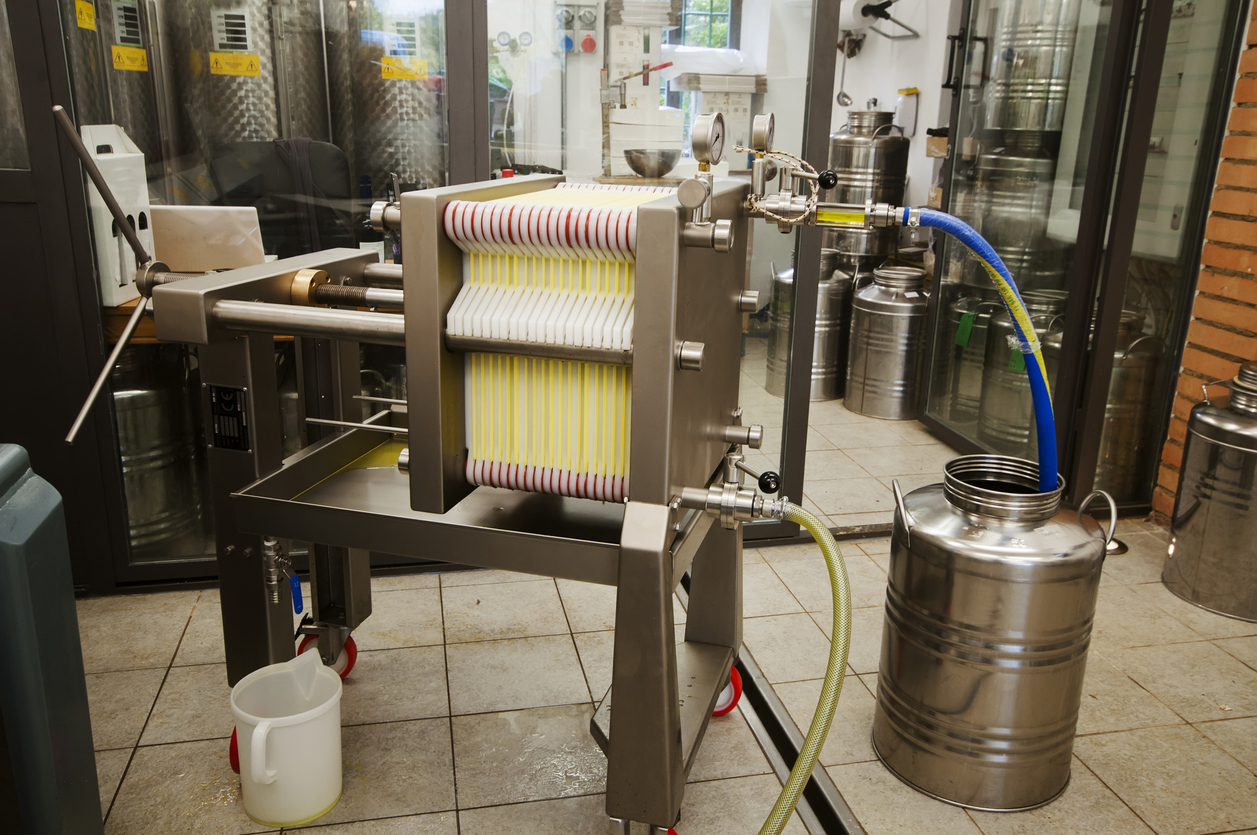
Sheet filter for wine - classic depth filtration
Layer filter consist of rectangular filter layers that are clamped between panels. These layers consist of cellulose fibres, often combined with diatomaceous earth, perlite and binding agents. Filtration takes place into the depthsParticles accumulate inside the layer, not just on the surface.
Advantages:
- Wide range of pore sizes (from coarse to sterilising).
- Good particle absorption, therefore relatively long service life.
- Fine control of the filtration performance by combining different layers.
Disadvantages:
- Consumables that must be disposed of after use.
- Risk of sensory interference if the layers are not rinsed correctly („layer flavour“).
- With very high lees content, rapid increase in differential pressure, frequent shift changes.
For many quality-orientated companies Layer filter combined with an EK membrane in front of the filling is the backbone of filtration today.
Diatomaceous earth and perlite filtration - strong workhorses, but declining in the premium segment
With the Diatomaceous earth filtration (often in chamber filters, candle or disc filters), a layer of finely ground diatoms (diatomaceous earth) is floated onto a carrier. The wine flows through this layer, lees accumulate and the filtration fineness depends on the particle size of the diatomaceous earth.
Advantages:
- High performance, suitable for large volumes.
- Good adaptability to different degrees of turbidity.
Disadvantages:
- Dusty filter aids, occupational safety and disposal as an issue.
- Risk of „over-filtering“ if too fine qualities or too many passes are used.
- No longer state of the art in very high-quality, small-structured cellars that rely on crossflow or sheet filters.
Perlite as a filter aid works in a similar way, but has different physical properties. Both technologies remain relevant in larger, industrially orientated wineries; in smaller, top-quality wineries, sheet filters, crossflow and precise membrane technology tend to dominate.
Membrane filtration, EK filtration and simplex filters for very small quantities
Membrane filter are thin polymer-based films with a defined pore size. They work purely as surface filters: everything that is larger than the pores remains on the surface.
Areas of application:
- Sterilisation filtration before filling (EK filtration).
- Polishing filtration after a crossflow system.
- Filtration of small batches or test series.
Simplex filter are compact housings containing a single filter cartridge. They are used for pre- or fine filtration of small volumes, e.g. for individual barrique extractions or for stability testing in the laboratory.
Crossflow filtration: a milestone in modern cellar technology
The Crossflow filtration (cross-flow filtration) is now regarded as one of the most elegant methods for the Filtration of the wine. Their functional principle:
- The wine flows parallel to the membrane surface.
- A small part of the volume passes through the membrane as filtrate.
- The rest is recirculated, taking deposited particles with it and thus continuously cleaning the membrane surface.
Advantages in practice:
- Gentle treatmentLess pressure peaks, less oxygen absorption, good flavour retention.
- High clarityDepending on the membrane fineness, the filtrate is often already sufficient as sterilised wine for filling.
- No additional filter aidLess consumables, easier disposal, better ecological balance.
Disadvantages:
- High investment costs for the system.
- Expertise required in handling (flow rates, backwash cycles, cleaning).
Especially quality-orientated companies whose wines you can buy at White wines in the range use crossflow to polish fine fruity wines without „filtering them dry“.
Fining vs. filtration: Why wine is not only sieved, but also „fined“
The terms Finishing and Filtration of the wine mixed. Technically, these are two different steps that often follow each other.
What does „beautiful wine“ mean?
At the Beautiful the cellar adds an additive to the wine that specifically binds undesirable substances:
- Proteins (to avoid protein turbidity).
- Phenols and tannins (for astringent or bitter wines).
- Metal ions that promote oxidative instability.
Classic fining agents:
- Animal products: Gelatine (often from pork or beef), isinglass (fish bladder), egg white (chicken egg white), casein (milk protein).
- Mineral/vegetable products: Bentonite (clay mineral), activated charcoal, pea protein, potato protein, vegetable gelatine alternatives.
The additive binds target substances, flocculates and is then removed by sedimentation, tapping and Filtration removed.
Filtration after fining
A fining is almost always followed by a Filtration of the wine, to discharge the formed flakes and bound substances. This is where the line often becomes blurred for consumers: „Beautiful wine with gelatine“ does not mean that gelatine is in the filter, but that gelatine was in the wine as a fining agent and is filtered out later.
From the point of view of a strict vegan diet, a wine treated in this way is not vegan, even if there are only traces or no detectable quantities of animal substances left in the end product.
If you would like to take a closer look at the role of fining in expansion, it is worth taking a look at the supplementary article Fining and filtration in the feiniwy.ch blog.
Is filtered wine vegan? - An overview of animal and plant-based aids
The term „Filtering wine the animal way“ draws attention to an important point: Animal substances are mostly used for fining, not for purely mechanical filtering. For many wine lovers who shop consciously, this differentiation is crucial.
Classic animal aids in winemaking
In the traditional cellar practice one used:
- Gelatine - from pork rinds or cattle bones, to reduce bitter substances and lees.
- Hausen bubble (fish bladder) - for particularly fine clarification, especially in white wine and sparkling wine („wine filter fish bladder“).
- Egg white - Traditionally used in barrique ageing of red wines to „round off“ tannins.
- Casein - Milk protein to remove oxidative notes and brown discolouration.
From a vegan point of view, such wines are considered not vegan, even if the additives are largely removed later by filtration.
Plant and mineral alternatives - filtering wine without animal products
Today, many quality-orientated wineries and organic wineries use vegetable or mineral fining agents:
- Bentonite - Removes proteins, prevents turbidity in white and rosé wines.
- Activated carbon - to remove unwanted odours and dyes (carefully dosed, as it also binds desired aromas).
- Pea or potato protein - plant-based alternatives to gelatine and egg white.
- Cellulose and other plant-based colloids - to fine-tune mouthfeel and stability.
Filtration media themselves - layers, membranes, crossflow membranes - are predominantly used in modern systems. Neutral and not animal. The decisive factor for vegan wine is therefore:
Fining must be carried out without animal products, and the wine is filtered using neutral filter media.
If you specifically vegan wine look for appropriate labelling on the label or in the product description in the shop, for example when selecting in categories such as Buy white wine or Buy red wine.
Wine filtration and style: How much does the filter influence the flavour?
Filtration not only has a technical effect, but also a sensory one. Three areas deserve special attention:
1. aroma and bouquet
Mild Fine filtration only removes coarse cloudy particles and largely leaves flavour precursors and colloids in the wine. Intensive filtration, especially in several stages or with very fine pores, can:
- partially adsorb volatile flavour compounds,
- change the redox balance,
- take away the wine's „gaps“, which are often responsible for complexity.
The result: a very clean, but sometimes also „smooth“ wine.
2. texture and mouthfeel
Cloudy particles, fine yeasts and colloids act like a delicate cushion on the tongue. If you remove too much of it, the wine will have an effect:
- slimmer,
- more acute in acidity,
- less creamy.
Especially with Chardonnay or Pinot Noir, which play on texture and length (see, for example, the article Grape varieties - Pinot Noir), ambitious cellar masters weigh up very carefully how far they filter.
3. maturity
Slightly cloudy, unfiltered or only lightly filtered wines mature differently. Microorganisms and colloids:
- can contribute to more complex maturity flavours,
- also increase the risk of bottle variance and off-tones.
Sterile-filtered wines mature more stably and predictably, but are often somewhat calmer. The market is differentiated in the premium segment: Some companies deliberately opt for unfiltered wines (with a corresponding note on the label), others on finely filtered precision.
Wine filtration in practice: typical process in the cellar
To make the various steps more tangible, the following table summarises the common stages of the Filtration of the wine together:
| Stage | Purpose | Typical technology | Influence on style |
|---|---|---|---|
| After pressing | Separation of coarse solids, preparation for fermentation | Sieve filter, coarse layer filter | Hardly any sensory influence, mainly technical protection |
| After alcoholic fermentation | Removal of the main yeast, reduction of the lees | Coarse to medium filtration, crossflow | Influence on texture and yeast character, deliberately controllable |
| Before / after BSA (biological acid degradation) | Control of lactic acid bacteria, stability | Targeted layer filters, partial filtration if necessary | Regulation of freshness and creaminess |
| Before the filling | Clarification, sterilisation, optical brilliance | Fine filtration, EK filtration, crossflow | Direct influence on clarity, stability, occasional fullness |
The exact sequence depends on the wine style, grape variety and ageing strategy. The process is different for a fresh Sauvignon Blanc than for a structured Bolgheri or a mature Pinot Noir from Graubünden.
If you would like to delve deeper into the sequence from the vineyard to the bottle, contributions such as Working in the vineyard, Pressing the grapes, Alcoholic fermentation, Biological acid degradation (BSA) and Ageing of the wine the picture.
When is the wine filtered?
The question „When is the wine filtered?“ accompanies every cellar planning. In practice, filtrations take place at several points in time:
- Directly after pressingCoarse filtration of must or young wine if the lees content is very high.
- After alcoholic fermentationRemoval of the yeast sediment after an initial maturation phase on the full lees.
- After malolactic fermentationClarification and stabilisation, especially for red wines and some white wines with BSA.
- Before the fillingDecisive fine or EC filtration for clarity and microbiological safety.
Not every wine goes through every step. Natural wine-oriented wineries do not filter at all or only minimally, while larger wineries and private labels standardise more in order to offer uniform quality. For the selection in the feiniwy.ch range, the Felber wine office emphasises that these steps are not dogmatic, but stylistically based.
Filtering wine at home - what makes sense and what doesn't
The search query „Filtering wine at home“ appears again and again, for example when:
- even fermented must or hobby wine has remained cloudy,
- a purchased wine shows slight deposits,
- a secondary fermentation in the bottle has produced yeast haze.
How can I filter wine?
Pragmatic solutions are recommended for domestic use:
- Coarse coffee or tea filter for visual clarification of small quantities. This removes coarser lees, but is slow and not microbiologically safe.
- Gravity and pull-offLeave the bottle or balloon cool and still for several days, then carefully remove the clear part from the top or using a tube.
- Hobby filter systems with small sheet filters (table-top devices), as used in hobby viticulture.
What you should know:
- Household filters do not replace EK filtration. They produce clarity, but not sterile sterilisation.
- Each filtration step can also lead to changes in flavour. If in doubt, it is better to enjoy a wine that is imperfect but full of character than to over-engineer it.
- The wine connoisseur traditionally treats wines that have already been filled with sediment (e.g. matured red wine) by Decanting, not by filtering.
For high-quality bottles from the feiniwy.ch range, the Felber wine office advises against additional filtering at home. Careful decanting, especially for mature red wine or complex white wine, is usually sufficient.
„Wine filter pig“, „wine filter fish bladder“ - what's behind these buzzwords?
Search terms like „Wine filter pig“, „Wine filter fish bladder“ or „Filtering wine is not vegan“ reflect the growing awareness of ingredients and production processes.
Short and clear:
- „Pig“ refers to gelatine, which is often obtained from pork rinds or bones.
- „Fish bladder“ means isinglass, a classic fining agent made from the dried swim bladders of large fish that is rarely used today.
- „Not vegan“ means that animal products were used in the fining process, regardless of whether they are later removed by filtration.
This raises practical questions for consumers:
- How do I recognise vegan wine?
Look out for appropriate labelling, vegan seals or clear information in the product description. Premium retailers such as feiniwy.ch generally provide transparent information. - Can I taste the difference?
In sensory terms, the difference is not the animal origin of the aid, but the intensity of the fining and filtration. Well-made vegan wines are in no way inferior to classic wines in terms of quality.
Filtration of the wine in the context of the entire vinification process
The Filtration of the wine never unfolds its effect in isolation, but is part of a dense structure of further steps:
- Working in the vineyardHealthy, ripe grapes require less corrective intervention in the cellar. The cleaner the grapes, the milder the filtration.
- Pressing the grapesGentle pressing at low pressures produces clearer musts and wines with less coarse lees. This significantly reduces the burden on filtration.
- Alcoholic fermentationClean, controlled fermentation produces fewer unwanted by-products that would later have to be removed by fining or filtration.
- Biological acid degradation (BSA)Its management influences the need for subsequent filtration, especially in the control of lactic acid bacteria.
- Ageing of the wineAgeing on the lees, barrel ageing, batonnage and temperature control determine how stable and clear the wine is before final filtration.
Anyone who reads the articles on these stations in the feiniwy.ch blog will recognise them: Filtration is the logical consequence of the previous decisions. It does not „correct“, but shapes the result that was previously created.
Practical orientation: When filtration strengthens sensibly - and when restraint is more appropriate
From the point of view of Weinbüro Felber, some practical guidelines can be formulated:
- Fresh, fruity white wines and rosés benefit from a clear appearance and microbiological stability. A well thought-out combination of fining (preferably vegan) and moderate EK filtration or crossflow creates clean, exciting wines.
- Tannin-rich red wines such as Cabernet Sauvignon, Sangiovese or Tempranillo tolerate less filtration. Too much intervention takes away their grip and length. Good sedimentation, gentle layer filtration and - in the case of high-risk wines - a finely tuned fining stage are often sufficient.
- Sparkling wines and champagne must be extremely stable and clear, as secondary fermentation in the bottle has undesirable effects. Here, production traditionally works with finely tuned finings and precise filtration.
- Orange Wines and Natural Wines are partly defined by the fact that filtration is minimal or non-existent. Those who choose these wine styles consciously accept a higher turbidity and, in some cases, bottle variance.
For the selection at feiniwy.ch this means: not a scheme F, but stylistically based cellar work. Every product in the range bears this signature - from fresh white wines and elegant rosés to complex red wines from Italy, Spain, France and Switzerland.
Frequently asked questions about wine filtration
When is the wine filtered?
The Filtration of the wine is usually carried out at several points: after pressing (coarse filtration of the must or young wine), after alcoholic fermentation (separation of the main yeast), after malolactic fermentation and directly before bottling (fine or secondary filtration). The last step ensures clarity, stability and a clean appearance in the bottle. Depending on the style of wine, the cellar master reduces some of these stages or deliberately chooses minimally invasive filtration.
How can I filter wine?
In the hobby sector, filtering small quantities of wine works with simple means: Coffee or tea filters for coarse clarification, hobby layer filters or slow extraction of the clear portion after sedimentation. These methods ensure visual clarity, but are no substitute for the professional EK filtration used in wineries. For high-quality bottles from specialist retailers, such as feiniwy.ch, correct decanting is sufficient instead of filtering the wine at home.
What types of filtration are there?
In practice, cellar masters distinguish between several Types of filtration for wineCoarse filtration (sieve filters, coarse layers), fine filtration (layer filters, crossflow), diatomaceous earth or perlite filtration and EC filtration with membrane filters for sterilisation. There are also special applications such as sterile filtration of sweet wines or the filtration of base wines for sparkling wines. Which technology is used depends on the style of wine, desired clarity and stability requirements.
What is wine filtration?
The Filtration for wine refers to the separation of solids and microorganisms using a filter. The aim is to retain lees, yeasts and bacteria so that the wine reaches the bottle clear, stable and visually appealing. Depending on the technique - from sheet filters to kieselguhr to crossflow and EK filtration - this step has a stronger or milder effect on flavour, texture and ageing potential.
Is filtered wine vegan?
Filtered wine is only vegan if no animal products were used in the fining process and the filter media itself does not contain any animal components. Traditionally, gelatine (also from pigs), fish bladder, egg white or casein are used for fining. Wines that have been treated with such agents are not considered vegan from a vegan perspective, even if filtration later largely removes these additives. Vegan wine uses vegetable or mineral additives and neutral filter media and is labelled accordingly.
Why is wine flavoured with gelatine?
The practice „Fine wine with gelatine“ aims to bind excessive tannins, bitter substances and cloudy substances. Gelatine combines with these substances, flocculates and is then removed by sedimentation and Filtration of the wine removed. The result is a softer, clearer wine. Today, many quality-orientated wineries use vegetable proteins or bentonite instead of gelatine to produce vegan wines that are also precisely fined.
What does EK filtration mean for wine?
The EK filtration for wine stands for sterilisation filtration. In this process, the wine flows through membrane filters with a defined pore size (e.g. 0.45 µm), which retain yeasts and most bacteria. This step takes place immediately before bottling and ensures microbiological stability, especially for residual sweet wines, fruity white wines and light rosés. For the filtration of wine in modern cellars, EK filtration is one of the most important tools for ensuring quality in the long term.
///Comment: Tips for external links for E-E-A-T (Note: depending on the language, the output here is in de-DE)
- https://www.agroscope.admin.ch/agroscope/de/home/publikationen/suchen.html - Agroscope search page; here you will find in-depth specialist literature on winemaking, stability and filtration. Suitable after the sections on practical cellar practice and the table on filtration stages.
- https://www.bvl.bund.de - Federal Office of Consumer Protection and Food Safety; background information on food law requirements, labelling and additives, suitable in the section on vegan vs. non-vegan filtration and fining agents.
- https://www.lwg.bayern.de/weinbau/ - Bavarian State Institute for Viticulture and Horticulture; technical data sheets on filtration, fining and cellar technology. Recommended as a link after the sections on sheet filters, kieselguhr and crossflow.
- https://www.dlr-rlp.de/de/weinbau/kellerwirtschaft - Dienstleistungszentren Ländlicher Raum Rheinland-Pfalz; practical information on cellar management, wine filtration and stabilisation, following the presentation of the typical filtration process.
- https://www.oiv.int - International Organisation of Vine and Wine; standards and recommendations for winemaking, including fining and filtration processes. Useful at the end of the chapter on international standards and vegan alternatives.
- https://www.uvm.edu/~sdunning/wein - University teaching materials on oenology (where available); supplement with scientific focus on membrane filtration and influence on aromas, suitable after the section on crossflow filtration and EC filtration.
Wines at fair and transparent prices
feiniwy.ch
- Sales
- Novelties
- Alcohol-free products
- Red wines
- White wines
- Rosé wines
- Sparkling wines/champagne
- Olive oil
Felber wine office
feiniwy.ch